When people start to think about fostering, it can be easy for them to feel overwhelmed with the choice of agencies and breadth of information to take in. Fostering with a charity might not seem that different from fostering with a local authority, but it affects everything from the type of children people look after to the level of support available.
St Christopher’s is a charity set up in 1870 that runs residential and fostering services for young people in the UK and Isle of Man. Its carers often say that its charitable status was one of the reasons they chose to foster with St Christopher’s rather than another agency.
Dean fostered with his local authority before transferring to St Christopher’s. He says: “The fact that St Christopher’s is a charity was the main pull for me. We care who we foster with because despite appearing to be the same there is a clear distinction between agencies – charities have no motive to make profit or pay shareholders. Instead they can focus on providing excellent services.”
Local authorities are often the first place people turn to when they start to think about fostering. So what are the differences between a charity and a local authority?
Linda Smith fosters a group of young siblings. She says: “I know some people who foster for a local authority and they are impressed by how much training we are offered, how many activities are put on for the children and how as foster carers we are genuinely treated as part of the team.”
Kevin Lane transferred to St Christopher’s from an independent for-profit fostering organisation: “We were horrified to hear of children as ‘financial heads’ – money had become their priority and it didn’t sit well with us.
“Since moving to St Christopher’s we’ve been very happy,” he says. “Obviously an organisation needs to be run efficiently but with a charity you know that children are central to the decision-making process – just as they should be.”
Putting young people first has always been a key part of St Christopher’s ethos. It runs a successful participation programme and goes the extra mile so children can have their say. Without this high level of support, many young people would lack the confidence to speak up.
Top level support is offered to carers too. Jo Richards has been fostering with St Christopher’s for four years, after initially looking into becoming a carer with her local authority. She says: “Charities seemed to offer so much more support. When you’re a new carer they’re with you for every step of the way – the application process, when a child moves in with you and when new situations arise that you aren’t sure how to manage yet.”
It’s not only with the professionals that carers can find support. Unlike most local authorities and larger agencies, St Christopher’s has a proper fostering community – carers can attend monthly group sessions to build friendships and share their experiences. There’s a family feel to everything it does – staff, carers and children all know each other and enjoy spending time together.
Smith says: “The family feel is crucial because it means the children feel at home and they become confident enough to get involved with activities.
“Without realising, they learn to start trusting again – it’s a really important part of their healing process.”
Richards agrees: “Staff take the time to understand you, your family and the young person in your care. Children aren’t just a case number and because it’s a smaller team everyone knows each foster family’s dynamics. The personal touch makes a huge difference when you’re phoning someone in the early hours of the morning looking for some extra support.”
Being family-oriented plays a role in the long-term. As all staff know each carer and child, there’s continuity – something that is vital for children in care. They’ve often been let down by adults in the past and need people they can rely on. St Christopher’s unique combination of brilliant foster carers and experienced staff means it can get better outcomes for the young people it looks after.
“I love being a part of St Christopher’s long tradition of creating brighter futures for one of the most vulnerable groups in society,” says Dean. “Especially when the only ones who profit are the young people in need.”
If you’re thinking about fostering, visit St Christopher’s website.
This article was originally published as a paid advertorial on the Guardian's website.

Showing posts with label foster carer. Show all posts
Showing posts with label foster carer. Show all posts
Thursday, 20 April 2017

Thursday, 6 October 2016
What’s it like to be a male foster carer?
When you’re thinking of fostering, there are lots of things that won’t affect your eligibility – your age, your sexuality, your marital status or your religion. But why are there so few male foster carers in the job?
Keith and his wife Carol foster with us in Essex. He wants more men to step up as foster carers and realise that they can make just as much difference to a young person’s life as women can.

Keith and his wife Carol foster with us in Essex. He wants more men to step up as foster carers and realise that they can make just as much difference to a young person’s life as women can.
I was at a training session on equality and diversity recently and it made me think about the misconceptions people have when you’re a male foster carer.
When my wife and I first thought about fostering, she had to give me an extra push to make me recognise that I could do it. The hardest thing you have to overcome as a male carer is the stereotype that you won’t be as caring as your female equivalent. It’s simply not the case – people ask what I do in fostering and expect to receive a different answer than the one my wife gives, but I do exactly the same.
Some people have suggested to me that men aren’t as trustworthy as foster carers and shouldn’t be allowed to do all the tasks involved, but I don’t think that’s fair. They don’t mean to be rude or upset me, it’s just a challenge for people to understand that gender doesn’t make a difference in fostering. Men don’t want to feel like the spare wheel in fostering – they want to feel like they’re an essential part of the car.
Often people have the impression that men should be checked out more thoroughly than women during the fostering application process, but the checks for everybody are really rigorous. You’ll be sussed out long before any young people move in with you and the staff are on-hand to provide any additional training or support that you might need.
I’m trying to encourage two of my brothers to start fostering too but they always ask whether I worry about looking after other people’s children. They have concerns about the risks and possible volatile situations they might be in, and think that women are better placed to handle these issues. I always ask them what makes me any different? Just because I’m a man doesn’t mean I can’t manage these challenges in a professional and caring way.
Valuing male foster carers’ input is really important. One of my previous foster children couldn’t have got where she was today without my support.
Children in care are all totally different – that’s why we need a mixture of foster carers to look after them. I want other men to realise how rewarding it can be and know that they’re capable of changing a young person’s life too.
When my wife and I first thought about fostering, she had to give me an extra push to make me recognise that I could do it. The hardest thing you have to overcome as a male carer is the stereotype that you won’t be as caring as your female equivalent. It’s simply not the case – people ask what I do in fostering and expect to receive a different answer than the one my wife gives, but I do exactly the same.
Some people have suggested to me that men aren’t as trustworthy as foster carers and shouldn’t be allowed to do all the tasks involved, but I don’t think that’s fair. They don’t mean to be rude or upset me, it’s just a challenge for people to understand that gender doesn’t make a difference in fostering. Men don’t want to feel like the spare wheel in fostering – they want to feel like they’re an essential part of the car.
Often people have the impression that men should be checked out more thoroughly than women during the fostering application process, but the checks for everybody are really rigorous. You’ll be sussed out long before any young people move in with you and the staff are on-hand to provide any additional training or support that you might need.
I’m trying to encourage two of my brothers to start fostering too but they always ask whether I worry about looking after other people’s children. They have concerns about the risks and possible volatile situations they might be in, and think that women are better placed to handle these issues. I always ask them what makes me any different? Just because I’m a man doesn’t mean I can’t manage these challenges in a professional and caring way.
Valuing male foster carers’ input is really important. One of my previous foster children couldn’t have got where she was today without my support.
Children in care are all totally different – that’s why we need a mixture of foster carers to look after them. I want other men to realise how rewarding it can be and know that they’re capable of changing a young person’s life too.
Watch Keith talk about his fostering journey on our YouTube channel now or visit our website to find out more.
Thursday, 29 September 2016
Sons and Daughters Month - Jackie's story
Sons and Daughters Month celebrates the difference that birth children make in fostering. Whether they're still young and living at home or have already flown the nest, having an extended family that care about your foster children makes a massive difference to their well-being and sense of belonging.
Jackie has been fostering with St Christopher's in the West Midlands for four and a half years. Her youngest son, Josh, still lives at home with Jackie and her foster daughter.

I’ve been fostering for four and a half years and have looked after the same young person, A, for the entire time. It’s gone really quickly and A has now started college.
My son Josh is 19 and still lives at home – my other children are older and have moved out. some even have children of their own now. He’s always been very laidback and never had any worries about fostering as my sister had been doing it for many years. He knew children that she had previously fostered and understood what it would be like.
I had a few discussions with all of my children, not just Josh, throughout the application process. They knew they could tell me if they had any doubts and that I wouldn’t go ahead with fostering unless they were completely happy.
A was challenging at the start. Everyone thought that she would be eager to leave as soon as she turned 16 but it hasn’t been like that at all, and I think that’s down to making her feel included in our lives.
At first it was hard for me and Josh to adjust. There are lots of new rules when you start fostering about not going in other children’s rooms and they must be stuck to. A had made a few allegations in the past against boys so safeguarding my son was a main priority.
When she moved in with me it was the first time A had lived with just one foster carer instead of a couple. It’s made her realise that not every child lives with both their parents. She saw that my son Josh relies on only me and I think it’s made her think differently about foster care.
My older son is a teacher and always advises A on problems at school and helps her with homework. I think she really benefits from knowing our whole family is behind her and gets a lot out of the extra support.
A always refers to Josh and my other children as her brothers and sisters. She is part of our family, she comes out for meals with us and goes to all our events. My birth children involve A in everything – and why wouldn’t they? I don’t think she would’ve minded being the only child in the house, but when she is treated like all of the others it does help her to feel more at home.
Fostering hasn’t changed my relationships with my children, but it has opened our eyes. When you have your own children you think you’ve seen it all but you really haven’t. It’s a learning experience.
Josh is thinking of moving out now so another foster child might be coming to live with me. I’m treating the topic with A the same way I did with my birth children – asking her if she would be OK with it and not going ahead with it if she has concerns. She was set against it at first but she’s starting to ask more questions now about what the person would be like and how old they would be, so she might come round when she’s older!
Would you like to make a difference to a child's life? Visit our website today to find out about fostering in your area.
Jackie has been fostering with St Christopher's in the West Midlands for four and a half years. Her youngest son, Josh, still lives at home with Jackie and her foster daughter.

I’ve been fostering for four and a half years and have looked after the same young person, A, for the entire time. It’s gone really quickly and A has now started college.
My son Josh is 19 and still lives at home – my other children are older and have moved out. some even have children of their own now. He’s always been very laidback and never had any worries about fostering as my sister had been doing it for many years. He knew children that she had previously fostered and understood what it would be like.
I had a few discussions with all of my children, not just Josh, throughout the application process. They knew they could tell me if they had any doubts and that I wouldn’t go ahead with fostering unless they were completely happy.
A was challenging at the start. Everyone thought that she would be eager to leave as soon as she turned 16 but it hasn’t been like that at all, and I think that’s down to making her feel included in our lives.
At first it was hard for me and Josh to adjust. There are lots of new rules when you start fostering about not going in other children’s rooms and they must be stuck to. A had made a few allegations in the past against boys so safeguarding my son was a main priority.
When she moved in with me it was the first time A had lived with just one foster carer instead of a couple. It’s made her realise that not every child lives with both their parents. She saw that my son Josh relies on only me and I think it’s made her think differently about foster care.
My older son is a teacher and always advises A on problems at school and helps her with homework. I think she really benefits from knowing our whole family is behind her and gets a lot out of the extra support.
A always refers to Josh and my other children as her brothers and sisters. She is part of our family, she comes out for meals with us and goes to all our events. My birth children involve A in everything – and why wouldn’t they? I don’t think she would’ve minded being the only child in the house, but when she is treated like all of the others it does help her to feel more at home.
Fostering hasn’t changed my relationships with my children, but it has opened our eyes. When you have your own children you think you’ve seen it all but you really haven’t. It’s a learning experience.
Josh is thinking of moving out now so another foster child might be coming to live with me. I’m treating the topic with A the same way I did with my birth children – asking her if she would be OK with it and not going ahead with it if she has concerns. She was set against it at first but she’s starting to ask more questions now about what the person would be like and how old they would be, so she might come round when she’s older!
Would you like to make a difference to a child's life? Visit our website today to find out about fostering in your area.
Tuesday, 27 September 2016
Sons and Daughters Month - Linda's story
Sons and Daughters Month celebrates the difference that birth children make in fostering. Whether they're still young and living at home or have already flown the nest, having an extended family that care about your foster children makes a massive difference to their well-being and sense of belonging.
Linda fosters with St Christopher's in the West Midlands. The support she's received from her own children has had a great impact on the young people she fosters.
 |
| Linda with St Christopher's Trustee Bert |
I’ve been fostering for three and half years and for most of this time I’ve been looking after a sibling group of three.
My birth children are all grown up aged 30, 33 and 35 and they’ve all got children of their own too. When we told them we were thinking about fostering they were all for it and thought it was a great idea.
Initially we were a bit worried about how our grandchildren would react but they totally accepted it and call our foster children their cousins. They spend every Saturday together as they’re roughly the same age and the two oldest ones both go to the same school.
I am particularly close to my oldest granddaughter who I had looked after a lot since she was a baby so I did wonder how she would behave when she saw me caring for another child. We discussed the idea of fostering with her throughout the whole application process and brought her along to buy all the things we’d need.
She was staying with us when our very first foster children arrived and instantly put the them at ease by giving them a tour of our house. Having someone there on their level definitely made a difference!
The first time my son met our current foster children was on a big family day out. They all got on really well and it was a completely natural transition.
Our middle foster child has had a really difficult time, but our oldest daughter has really taken her under her wing and tells her she will help as much as possible.
I think that having my family on board gives my foster children a feeling of acceptance. They send them birthday cards saying “brother” or “sister” on the front without us asking them to.
Fostering is normal for the whole family. I think if you can be relaxed about it then that’s half the battle – children can sense when you’re not being genuine and they’ll call you out on it.
That doesn’t mean it hasn’t been a learning experience. Children’s needs change all the time when they’re growing up so all of us have to adapt too. I learn something new every day and it’s really important for foster carers to be able to take constructive criticism on board and take direction if you’re doing something wrong.
Since we started fostering my family has knitted together and become more of a unit. They've adapted really well to the changes we've had to make to become a foster family and have never wavered in their support.
Fostering is normal for the whole family. I think if you can be relaxed about it then that’s half the battle – children can sense when you’re not being genuine and they’ll call you out on it.
That doesn’t mean it hasn’t been a learning experience. Children’s needs change all the time when they’re growing up so all of us have to adapt too. I learn something new every day and it’s really important for foster carers to be able to take constructive criticism on board and take direction if you’re doing something wrong.
Since we started fostering my family has knitted together and become more of a unit. They've adapted really well to the changes we've had to make to become a foster family and have never wavered in their support.
If my own children were a bit younger I would probably have worried about jealousy. However, we treat them all on an equal keel. There’s no “us versus them” because we’re all part of the “us”, in spite of the big age difference. We want everyone in our family to feel valued because they truly are.
Are you interested in fostering? Visit our website now to find out more.
Monday, 16 May 2016
Foster Care Fortnight 2016 – Connie’s story
We’re celebrating Foster Care Fortnight from 16-29 May and the theme for 2016 is Time to Foster, Time to Care. Every 20 minutes across the UK a child comes into care in need of a foster family.
Connie lives in Essex and has been fostering for about eight years. She shares her favourite fostering memories and explains why it’s such a rewarding career.

Why did you decide to become a carer?
Connie lives in Essex and has been fostering for about eight years. She shares her favourite fostering memories and explains why it’s such a rewarding career.

Why did you decide to become a carer?
I had always wanted to foster. My sister, who lives in Ireland, is a carer and so was the childminder who looked after my kids when they were younger.
St Christopher’s was actually the first organisation I saw an advert for so I just went ahead and phoned instead of waiting around for any longer. And I’m so glad I did!
How do you help young people settle into their new home?
For me it’s important not to make a huge deal of their arrival by not putting the spotlight on them. It’s a big move and they might be feeling anxious so I just welcome them in and invite them to have a chat. I’ll show them round the house, introduce them to the people they’ll be living with and talk to them about the area.
What are the biggest challenges of fostering?
I have always fostered teenagers with disabilities. I didn’t go into it with the idea of specifically fostering young people like this but the first boy I looked after had autism and it just grew from there. When he arrived I knew nothing about autism but St Christopher’s sent me on training courses to learn about different behaviours and how I could support him.
Sometimes young people with disabilities can totally switch their behaviour with no warning, which can be challenging at first. The training prepared me for these occasions and I really like that St Christopher’s gave me the opportunity to develop my skills and knowledge. It shows that they put the child’s needs first.
How do you juggle your job alongside the commitments of fostering?
I was so grateful that I could keep my job when I began fostering as lots of agencies don’t let you. Luckily my role is really flexible – for example, if there’s a problem at the school I’m able to go and sort things out. I can also take leave for fostering training days.
In my opinion it’s great for the children to be looked after by someone with a good work ethic. If they come into your home and see you going out to work they will learn that they’ll have to do the same when they’re adults.
Do you have a favourite fostering memory?
One child I looked after couldn’t read at 12 years old and was receiving no support from his school when he first came to live with me. He left that school and had help from a tutor and me so that he could learn to read, and he ended up winning an award for his achievement. It was a really proud moment!
Other things that stick in my mind are when foster children say “I love you” for the first time. You know then that they respect you and appreciate everything you’ve done. I’ve learnt an awful lot from the children that I foster, it’s a two-way thing.
I’m lucky enough to have good relationships with my foster children’s own families. We can all spend time together and have Christmas and birthday meals as a group. I feel like an extension of their birth family, which I’m so grateful for.
Being a carer does wonders for your own self-esteem too – you see a young person doing well and you know that you’ve had a positive hand in helping them get there.
What difference do you think you can make in 20 minutes as a foster carer?
Foster children often have low self-esteem so they need to be reminded that they’re part of your family and that they have a welcome place in your life. They want to know that you love them just as much as your birth children and can need more reassurance.
I remember when one boy first came to live with us he was sometimes aggressive towards my son. I realised that he was acting out because he was jealous so I took some time to make him understand that I love him just as much as my birth children. His behaviour really changed from this point onwards.
Showing you care and that you’re interested in what they have to say is so important. I always try to look at the positives in their development instead of focussing on the negatives, and talk to them a lot about this.
What do you like about fostering with St Christopher’s?
I love that it’s a small agency so you really feel like part of the family. Everyone is so friendly and they really care about you – you’re never left alone if you have a problem and there’s always somebody at the end of the phone who you can talk it through with. At first I didn’t know there was a difference between fostering with a Local Authority or a charity, but I am glad I ended up with a not-for-profit.
When new carers start, I always remind them not to be put off by the first hurdle because the outcomes are so rewarding. It can be challenging but you soon fall into your stride and seeing the difference in the child from when they first arrived is really worthwhile.
What would you say to someone who is thinking about fostering?
Do it! You can be a really positive influence in a young person’s life. Fostering is so, so rewarding and I would recommend it to anyone who wanted to make a difference.
We’re recruiting carers in the Eastern Region and the West Midlands. Find out more about fostering on our website today or call 0800 234 6282 for a no-obligation chat.
We’re recruiting carers in the Eastern Region and the West Midlands. Find out more about fostering on our website today or call 0800 234 6282 for a no-obligation chat.
Thursday, 28 April 2016
Foster Care Fortnight 2016 – Dean’s story
We’re celebrating Foster Care Fortnight from 16-29 May and the theme for 2016 is Time to Foster, Time to Care.
Every 20 minutes across the UK a child comes into care in need of a foster family. This year over 9,000 new carers are needed to provide safe, loving homes for vulnerable young people.
Dean is from Essex and has been a carer for about seven years. He spoke to us about why he wanted to get involved and shared some of his favourite fostering memories.

Every 20 minutes across the UK a child comes into care in need of a foster family. This year over 9,000 new carers are needed to provide safe, loving homes for vulnerable young people.
Dean is from Essex and has been a carer for about seven years. He spoke to us about why he wanted to get involved and shared some of his favourite fostering memories.

Why did you want to start fostering?
My mum was a carer so I grew up around fostering. It was something my wife and I had always wanted to do. We waited until our own children had grown up and left home before starting our application. Initially we thought we would give fostering a try for six months but the first young person we looked after came from such a chaotic background that we realised we had to see it through for their sake.
There are different types of fostering like short-term and respite, but we were more interested in looking after someone long-term because you see greater results. It’s so important to provide a stable home as it can take a young person a while to trust you if they have had bad experiences with adults before. You have to build up that relationship – that’s one of the main things that carers do.
You can have good intentions about how it will go but you never know until that first young person moves into your home.
How do you help young people to settle into their new home?
Moving into a new home is a really big thing for young people and we want them to feel as comfortable as possible. We let them choose their own bedding to personalise their room and we’re happy for them to put their own pictures on the walls. We ask what they like to eat so we can cook their favourite meals. It’s about empowering them to make responsible choices and showing them that we care right from the start.
Often the people we care for have been victims of neglect or abuse. They’ve been let down by the people who were meant to look after them and keep them safe. We acknowledge the past and the young person’s feelings, and give them space and time to talk about what’s happened. Through this we encourage them to think about the future and where they’re heading instead. We hope that they can begin to view life more positively.
How do you measure success when you’re fostering?
Young people who have been neglected, abused or have come from difficult circumstances often expect you to fail or let them down as this is often how adults have behaved around them before. They can be justifiably angry, upset or confused about their past and it might take some time for them to trust their foster carer. Sometimes they’ll ask if I’ve read their file but I always make it clear that we don’t make any assumptions based on the information we’ve been given and will deal with situations as they arise.
To begin with they might spend most of their time in their bedroom and will be reluctant to spend time with the family but then something changes. They’ll want to spend more time with you and to get involved in the household. They’ll even ask if you’re OK and start thinking about the people around them. When they do that you know things are beginning to progress well.
After a while you start to see their fear and anxiety drop away. They start to understand that you’re not going to give up on them and that they can stay in their new home. They realise how you can help.
Sometimes you can be fostering someone for 18 months or more and reflect back with them to see how far they’ve come. It just makes you realise how far they can go in the future.
What difference do you think you can make in 20 minutes as a foster carer?
Little conversations might seem inconsequential at the time but when you reflect afterwards you realise that it could be really important. Chats about school, friends and anxieties happen in short bursts but can give you a real insight into how a young person is feeling. We have the conversation on their terms and I give them positive affirmations whenever I get the opportunity.
When short-term interventions like these are repeated again and again they have a really powerful impact. The foster children get to know that you’re consistent and you can build up a strong relationship that will lead to good outcomes.
Why did you choose St Christopher’s?
I started fostering with my Local Authority before transferring to St Christopher’s for two main reasons. Firstly, they are a registered charity so their motive is to help children in care rather than to make money. All their income goes straight back into the young people.
Secondly, St Christopher’s were running a specialist fostering scheme at the time for carers who wanted more challenging placements. We were really interested in this type of fostering as we had both worked with teenagers for over 25 years, whether they were self-harmers, homeless or involved in the criminal justice system.
Since then we’ve fostered people with emotional difficulties, people with electronic tags and people who try to hurt themselves. They usually lack self-confidence which is understandable as they’ve been treated like they don’t matter.
What would you say to someone who is thinking about fostering?
Fostering is a real, tangible opportunity to make a positive impact on a young person’s life. You can be the first person to show them respect, provide a safe home, provide them with care and give them positive attention. It’s a really powerful thing and it’s so rewarding. We’ve got no plans to stop any time soon!
We’re recruiting carers in Essex and the West Midlands. Find out more about fostering on our website today.
My mum was a carer so I grew up around fostering. It was something my wife and I had always wanted to do. We waited until our own children had grown up and left home before starting our application. Initially we thought we would give fostering a try for six months but the first young person we looked after came from such a chaotic background that we realised we had to see it through for their sake.
There are different types of fostering like short-term and respite, but we were more interested in looking after someone long-term because you see greater results. It’s so important to provide a stable home as it can take a young person a while to trust you if they have had bad experiences with adults before. You have to build up that relationship – that’s one of the main things that carers do.
You can have good intentions about how it will go but you never know until that first young person moves into your home.
How do you help young people to settle into their new home?
Moving into a new home is a really big thing for young people and we want them to feel as comfortable as possible. We let them choose their own bedding to personalise their room and we’re happy for them to put their own pictures on the walls. We ask what they like to eat so we can cook their favourite meals. It’s about empowering them to make responsible choices and showing them that we care right from the start.
Often the people we care for have been victims of neglect or abuse. They’ve been let down by the people who were meant to look after them and keep them safe. We acknowledge the past and the young person’s feelings, and give them space and time to talk about what’s happened. Through this we encourage them to think about the future and where they’re heading instead. We hope that they can begin to view life more positively.
How do you measure success when you’re fostering?
Young people who have been neglected, abused or have come from difficult circumstances often expect you to fail or let them down as this is often how adults have behaved around them before. They can be justifiably angry, upset or confused about their past and it might take some time for them to trust their foster carer. Sometimes they’ll ask if I’ve read their file but I always make it clear that we don’t make any assumptions based on the information we’ve been given and will deal with situations as they arise.
To begin with they might spend most of their time in their bedroom and will be reluctant to spend time with the family but then something changes. They’ll want to spend more time with you and to get involved in the household. They’ll even ask if you’re OK and start thinking about the people around them. When they do that you know things are beginning to progress well.
After a while you start to see their fear and anxiety drop away. They start to understand that you’re not going to give up on them and that they can stay in their new home. They realise how you can help.
Sometimes you can be fostering someone for 18 months or more and reflect back with them to see how far they’ve come. It just makes you realise how far they can go in the future.
What difference do you think you can make in 20 minutes as a foster carer?
Little conversations might seem inconsequential at the time but when you reflect afterwards you realise that it could be really important. Chats about school, friends and anxieties happen in short bursts but can give you a real insight into how a young person is feeling. We have the conversation on their terms and I give them positive affirmations whenever I get the opportunity.
When short-term interventions like these are repeated again and again they have a really powerful impact. The foster children get to know that you’re consistent and you can build up a strong relationship that will lead to good outcomes.
Why did you choose St Christopher’s?
I started fostering with my Local Authority before transferring to St Christopher’s for two main reasons. Firstly, they are a registered charity so their motive is to help children in care rather than to make money. All their income goes straight back into the young people.
Secondly, St Christopher’s were running a specialist fostering scheme at the time for carers who wanted more challenging placements. We were really interested in this type of fostering as we had both worked with teenagers for over 25 years, whether they were self-harmers, homeless or involved in the criminal justice system.
Since then we’ve fostered people with emotional difficulties, people with electronic tags and people who try to hurt themselves. They usually lack self-confidence which is understandable as they’ve been treated like they don’t matter.
What would you say to someone who is thinking about fostering?
Fostering is a real, tangible opportunity to make a positive impact on a young person’s life. You can be the first person to show them respect, provide a safe home, provide them with care and give them positive attention. It’s a really powerful thing and it’s so rewarding. We’ve got no plans to stop any time soon!
We’re recruiting carers in Essex and the West Midlands. Find out more about fostering on our website today.
Friday, 22 April 2016
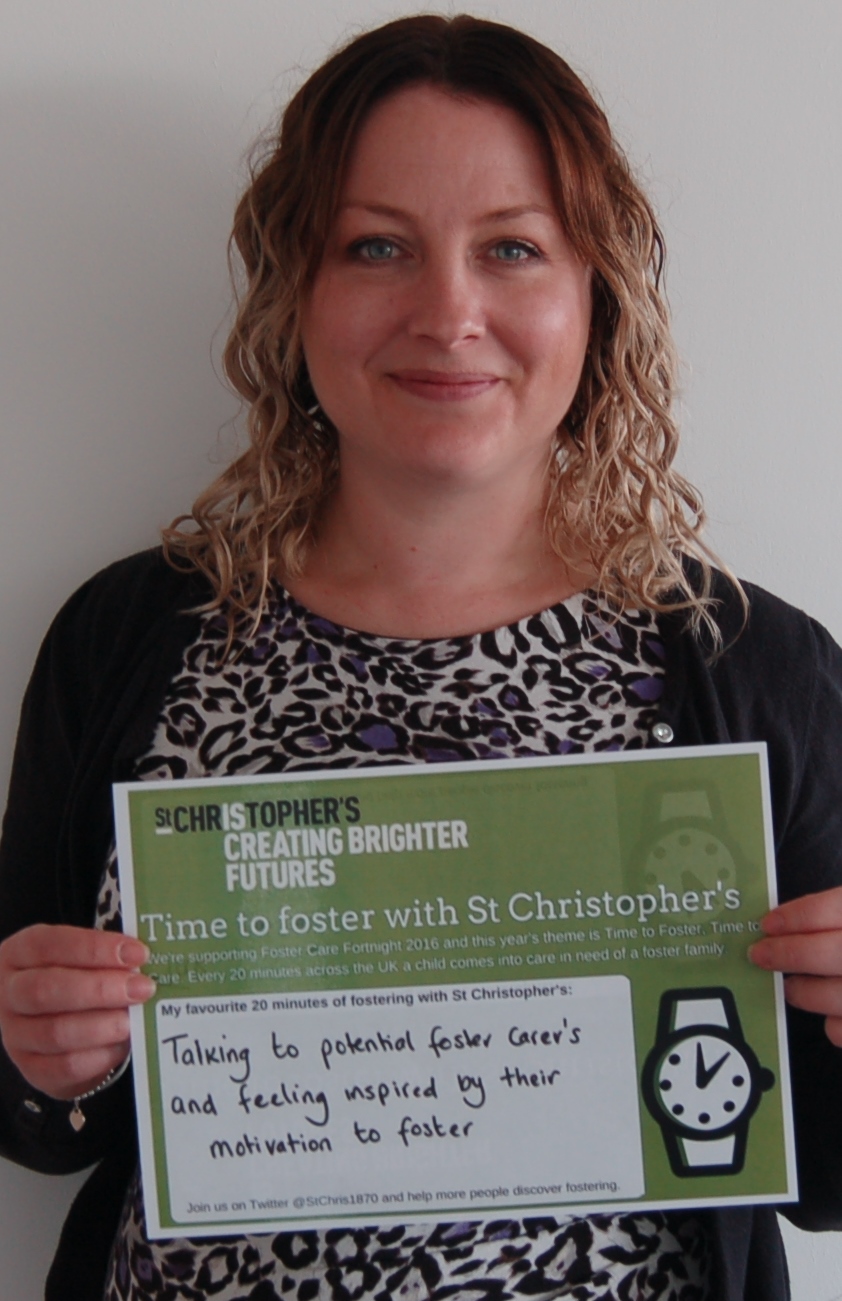
What can I learn about fostering in 20 minutes?
We’re celebrating Foster Care Fortnight from 16-29 May and the theme for 2016 is Time to Foster, Time to Care.
We’re a small fostering charity, so there’s a real family feel to what we do – our staff know each of our carers and children by name. Our carers are valued members of a team looking after a young person and they have 24/7 access to our experienced staff.
Unlike with larger agencies St Christopher’s has a proper fostering community. Each month our carers can attend a support group where they can meet each other and share their experiences.
We also hold annual achievement awards to celebrate the young people in our care and the milestones they’ve reached in the past twelve months. It’s at these events where you truly recognise the amazing impact that carers have.
What difference can a carer make to a child in 20 minutes?
Every 20 minutes across the UK a child comes into care in need of a foster family. This year over 9,000 new foster families are needed to provide safe, loving homes for vulnerable young people.
Kerryann O’Brien, Carer Recruitment Officer, explains what you could learn about fostering in 20 minutes and how your time can make a huge difference to a child.

What is fostering?
Most people have heard of fostering but they don’t usually know what’s involved. Fostering is when you welcome a child or young person into your home and support their development. You’ll provide a caring, safe home and work with their social worker, school and other professionals to make sure they reach their full potential.
What do people usually want to know when they get in touch?
When people get in touch about fostering they are usually just looking for reassurance that they can do it and that they’ll have help along the way.
Most carers have had experience with children before applying whether this is raising their own, working in a care-giving role or babysitting for friends and family. Fostering is very different, so they want to know how they’ll be supported to make the transition to caring for a vulnerable young person in their own home.
If you only had 20 minutes to talk about fostering, what would you say?
The first thing I would talk about is getting ready for fostering. It’s a big step for a lot of people so preparation is key – once a young person has moved in you can’t decide that fostering isn’t right for you and give up.
Explaining about our training is really important too. During the application process you’ll receive initial training where you learn what’s involved in fostering and how a carer fits into a young person’s life. After this you can access online training on young people’s development and will receive further in-house training throughout your fostering journey.
The final thing I talk about is the support carers receive from our social workers. Before a young person comes to live with you, you’ll receive as much information as possible about them so you know what to expect. With your social worker you can plan how to help that young person settle in, whether it’s through introducing a familiar routine or buying ingredients for their favourite meals.
Welcoming that first young person into your home can be nerve-wracking but remember your foster child probably feels even more nervous than you!
Explaining about our training is really important too. During the application process you’ll receive initial training where you learn what’s involved in fostering and how a carer fits into a young person’s life. After this you can access online training on young people’s development and will receive further in-house training throughout your fostering journey.
The final thing I talk about is the support carers receive from our social workers. Before a young person comes to live with you, you’ll receive as much information as possible about them so you know what to expect. With your social worker you can plan how to help that young person settle in, whether it’s through introducing a familiar routine or buying ingredients for their favourite meals.
Welcoming that first young person into your home can be nerve-wracking but remember your foster child probably feels even more nervous than you!
There’s a full list of Frequently Asked Questions available on our website.
What’s it like to foster with St Christopher’s?
What’s it like to foster with St Christopher’s?
Unlike with larger agencies St Christopher’s has a proper fostering community. Each month our carers can attend a support group where they can meet each other and share their experiences.
We also hold annual achievement awards to celebrate the young people in our care and the milestones they’ve reached in the past twelve months. It’s at these events where you truly recognise the amazing impact that carers have.
What difference can a carer make to a child in 20 minutes?
Tiny things can make a really big difference to a child in care. Listening to stories about their day, playing games and helping with homework all help a child to feel valued. These activities don’t take much time at all but will boost their self-esteem in the long term.
Using 20 minutes to advocate for a child’s rights by sorting out specialist support at school or arranging contact with their siblings is another way you can actively change their life for the better. Children in care often don’t have the confidence to speak up for themselves so foster parents need to be on their side.
Teaching them how to look after themselves properly or how to cook their favourite meal might take only 20 minutes but the skills they learn will benefit them for the rest of their life.
Making a child feel like part of your family goes such a long way. Use 20 minutes to get your relatives on board with fostering – not only can they offer you support in challenging times, it’s lovely for a child to have an extended family that they can spend time with.
How can I find out more?
Visit our website now to learn more about fostering.
We are recruiting carers in Essex and the West Midlands. Find out more about fostering in your area today.

Using 20 minutes to advocate for a child’s rights by sorting out specialist support at school or arranging contact with their siblings is another way you can actively change their life for the better. Children in care often don’t have the confidence to speak up for themselves so foster parents need to be on their side.
Teaching them how to look after themselves properly or how to cook their favourite meal might take only 20 minutes but the skills they learn will benefit them for the rest of their life.
Making a child feel like part of your family goes such a long way. Use 20 minutes to get your relatives on board with fostering – not only can they offer you support in challenging times, it’s lovely for a child to have an extended family that they can spend time with.
How can I find out more?
Visit our website now to learn more about fostering.
We are recruiting carers in Essex and the West Midlands. Find out more about fostering in your area today.

Monday, 1 February 2016
What skills do carers think you need to foster?
However we wanted to know what characteristics our carers think are essential for fostering – after all, they’re the ones doing the job. Here are some suggestions from our carers in the West Midlands:

Fostering is when you look after someone’s child in your own home, which is a big responsibility. It’s really important that you can be natural and authentic when you interact with a young person so that you can build up a strong, positive relationship.
Someone willing to get their own family involved
Having the support of your relatives, friends and neighbours can make a huge difference when you’re fostering. Everyone in your life should treat your foster child exactly like your own child so that they feel a sense of belonging and have the chance to experience a normal childhood.
Someone with a big heart, who can show genuine love
Children in care have sometimes lacked stability in their life and can be wary of becoming too settled with one family. If you can show them that you truly care about their life and their decisions, it will make a huge difference to their self-esteem.
Someone who has coped with challenges in their own life
Going through difficult periods and coming out on the other side gives you greater empathy and understanding. You can use these experiences in fostering by reflecting on what helped you during these times and offering the same support to a vulnerable young person.
Someone with self-awareness and the ability to reflect
Fostering is a really challenging job and sometimes everyone needs a bit of a break. It’s OK to take a step back and ask for help, whether it’s from your social worker, family or friends.
Someone who is willing to break out of their comfort zone
St Christopher’s offers regular training sessions to make sure you’re the best foster carer you can be because we think this gives better results for children and young people. Our carers all agree that they come away having learnt something new each time.
Someone willing to work with lots of other people as part of a team
As a foster carer you’re part of a team looking after a child or young person. You will have to be open to everyone’s ideas and suggestions, keeping the young person at the forefront of your mind.
Someone who is confident enough to advocate for the child in a professional way
Sometimes young people can find it challenging to express their opinions, particularly if it goes against the decisions that adults want to make. A carer should be able to speak up on the child’s behalf and make sure their voice is heard.
Someone open-minded and able to think outside of the box
Looked After Children often have different experiences to the majority of young people. Even if you can’t relate to these experiences personally you should be open-minded, non-judgemental and empathetic.
Someone fun with a sense of humour
Above all, you need to know how to have fun!
Do you know anyone with some or all of these skills who you think would make a good carer? Ask them to speak with Kerryann O’Brien, Carer Recruitment Officer, via email or on 0800 234 6282 today.
Thursday, 28 January 2016
What’s it like to go to panel with St Christopher’s?
The final stage of becoming a carer is attending a fostering panel meeting, where it will be decided whether you should be recommended for approval.
We know that the idea of sitting in front of a panel can be nerve-wracking, so we want you to be as prepared as possible for this last step. Fostering Panel Administrator Debbie Stone explains what you can expect at your meeting.

Who makes up the panel?
The panel is a group of people who decide whether to recommend you as a foster carer. My role is to take the minutes of everything discussed.
We know that the idea of sitting in front of a panel can be nerve-wracking, so we want you to be as prepared as possible for this last step. Fostering Panel Administrator Debbie Stone explains what you can expect at your meeting.

Who makes up the panel?
The panel is a group of people who decide whether to recommend you as a foster carer. My role is to take the minutes of everything discussed.
Everyone involved has an interest in fostering, whether they are social workers, carers or children who have been in care. Other panel members may have specialist skills in medicine or education. Their combined experience means they are best placed to recommend people to be foster carers.
There are usually at least six people on the panel and it will be headed by a chairperson who has significant experience of working with children and families.
What can I expect to happen on the day?
Your social worker will go in first to present your assessment and answer questions from the panel. You will then be invited into the meeting room and asked questions about your assessment so that the panel can get to know you personally.
It’s a great opportunity for you to feel involved in the decision-making process and to ask the panel any questions you may have, but don’t feel obliged to!
How do I know if I have been approved?
After the meeting the panel will discuss your assessment and make a recommendation about whether you should start fostering. It is unusual for a carer not to be approved at this point.
The final decision lies with the Agency Decision Maker, Ron Giddens, who is also Director of Operations at St Christopher’s. He will agree or disagree with the recommendation and will write to you in seven days to let you know.
You’ll be able to start fostering as soon as you receive your approval letter. Congratulations!
If you think you would be a great foster carer, get in touch with us today.
There are usually at least six people on the panel and it will be headed by a chairperson who has significant experience of working with children and families.
What can I expect to happen on the day?
Your social worker will go in first to present your assessment and answer questions from the panel. You will then be invited into the meeting room and asked questions about your assessment so that the panel can get to know you personally.
It’s a great opportunity for you to feel involved in the decision-making process and to ask the panel any questions you may have, but don’t feel obliged to!
How do I know if I have been approved?
After the meeting the panel will discuss your assessment and make a recommendation about whether you should start fostering. It is unusual for a carer not to be approved at this point.
The final decision lies with the Agency Decision Maker, Ron Giddens, who is also Director of Operations at St Christopher’s. He will agree or disagree with the recommendation and will write to you in seven days to let you know.
You’ll be able to start fostering as soon as you receive your approval letter. Congratulations!
If you think you would be a great foster carer, get in touch with us today.
Subscribe to:
Posts (Atom)